

Grounding
Introduction
Nightmare
- What narratives or tactics prevent your organization from sharing power with community? Why are they effective?
- Who typically deploys them? What is your own role/relationship to those tactics and narratives?
- How are they shaped by internal forces v. external forces?
Hope
- What do you see happening in community that represents creativity and innovation that you would like to see your institution support?
- When have you been able to overcome these tactics in your institution?
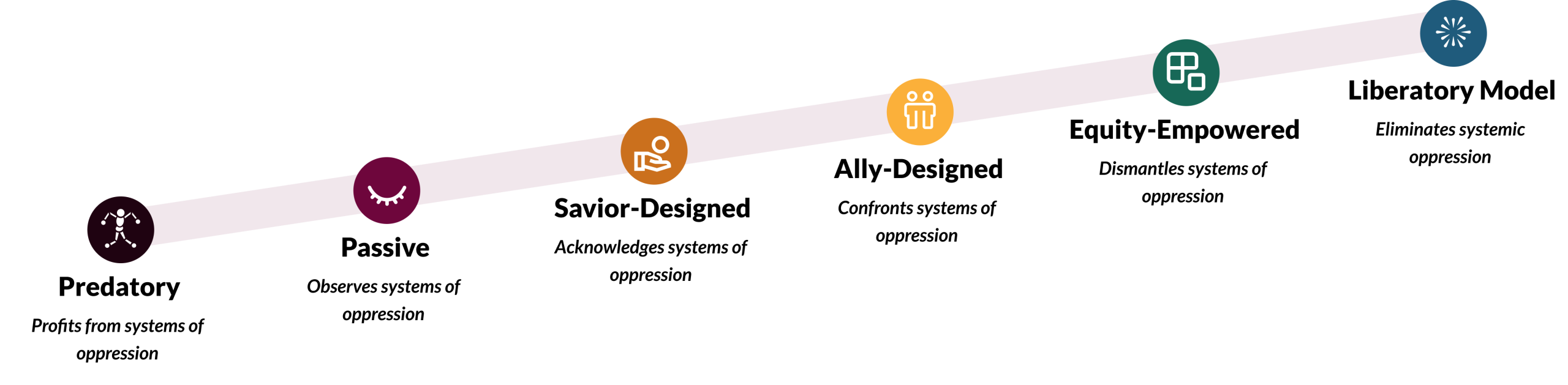
The current state of population and community health also exists along a continuum, and each system’s approach is differentiated by how it centers the community. Every system or intervention has the ability to produce harm, however, the response to the harm is what creates the lasting effect and represents the opportunity to advance more equity-forward and liberatory models of accountability and shared power. System types in the image are adapted from the National Institute for Children’s Health Quality.
Part Two
Intro to the 4 D’s
1
Deny
Opposing the collection of racial data gathering
2
Distance
Focusing on a non-racial identity that is subject to discrimination.
Focusing on personal hardships instead of race.
3
Distort
Focusing on implicit bias training solely despite evidence showing neutral or negative effects on people’s attitudes toward Black, Indigenous, People of Color.
4
Dismantle Unjust Systems
Counter distortion with a vision grounded in justice.
Move beyond a return on investment (ROI) case.
Prioritize long-term equity and justice over the possibility of short-term losses.