

Trust Assessment Rubric
for Health Institutions and Community Partners
Introduction
Advancing Community Governance of Health Equity Resources
Health institutions seeking to advance health equity must create conditions where trust can thrive—not just through words, but through action. This assessment tool, developed through Shift Health Accelerator’s application of the Bio360 Trust Framework, helps health institutions evaluate approaches that foster authentic, trust-based partnerships with communities. This assessment recognizes that trust-building is a foundation upon which health equity, racial justice, and healing can be built.
Specifically, the assessment tool helps health institutions evaluate their approach to trust-building and power-sharing in decision-making and resource governance over health-related funding, a key, but often overlooked, determinant of health. The health ecosystem, which encompasses healthcare institutions, health plans, philanthropy and conversion foundations, impact investing, public health, and other agencies, holds significant and diverse capital meant to strengthen equitable health outcomes in community settings.
However, much of this health-focused capital is traditionally invested in projects and programs driven by institutions’ own priorities, rather than into community-led solutions that successfully advance health equity. Accordingly, the tool places particular emphasis on how institutions share decision-making authority over various forms of capital—including grants, investments, endowments, and operating budgets—recognizing that financial governance is a critical indicator of genuine power-sharing necessary to achieve health equity.
When health institutions shift from traditional top-down resource allocation to participatory models where communities have meaningful control over financial resources, they address historical power imbalances that have undermined trust and deepened inequities.
A foundational input for this assessment is the recently launched Bio360 Trust Framework, which draws on biomimicry to understand how trust-like dynamics emerge in living systems across eight domains: Willingness, Discovery, Familiarity, Honesty, Cooperation, Reliability, Boundaries, and Feedback Loops. Shift Health Accelerator has adapted these insights specifically for health institutions making commitments to health equity work, translating biological principles into practical approaches for reshaping resource governance between health institutions and communities. The Bio360 framework reveals deep and broad insights about creating conditions for trust to emerge—findings directly applicable to health institutions seeking to build authentic partnerships with communities.
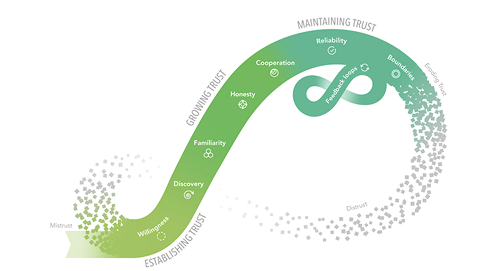
Learn more: https://bsisocial.org/nature-of-trust
From Scores to Action

section One
Using the Assessment Tool
This tool provides a framework for institutional reflection and action. For each domain, institutions evaluate trust-building behaviors, partnership readiness, and support for community governance and agency using a 1-5 scale:
1
Extractive
Community treated as passive subjects
2
minimal
Tokenistic involvement
3
developing
Emerging collaborative practices
4
Substantive
Meaningful but not fully integrated
partnership
5
transformative
True co-governance and shared decision-making
section two
trust assessments
1. willingness
willingness
Key Question:
2. Discovery
3. Familiarity
4. honesty
5. Cooperation
6. Reliability
7. Boundaries
8. feedback loops
Provide Your Details to Access Your Full 8-Step Assessment Summary
- 34-68 Extractive relationship requiring fundamental transformation
- 69-102 Early developmental stage with significant room for improvement
- 103-136 Emerging partnership with positive elements but key gaps
- 137-170 Strong foundation with opportunities to deepen authentic partnership
section three
interpreting your score
34-68
69-102
103-136
137-170
- 34-68 Extractive relationship requiring fundamental transformation
- 69-102 Early developmental stage with significant room for improvement
- 103-136 Emerging partnership with positive elements but key gaps
- 137-170 Strong foundation with opportunities to deepen authentic partnership